
"Everybody needs to be complicit with the fact that I’m gambling this company’s future on how I think people are going to want to sit on their bike"
"I am not anti-aero. I am however a strong advocate of aero-appropriate"
The Myth of Aero
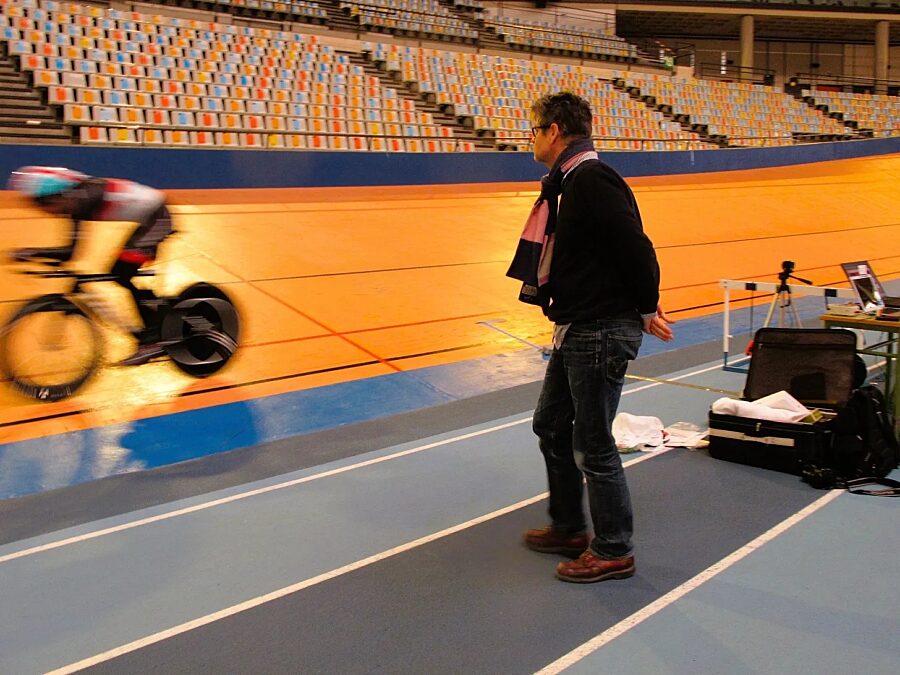
For the sake of clarity I am not anti-aero. I am however a strong advocate of aero-appropriate. Aero has to fit the person and their circumstances. I have spent countless hours perfecting professional rider’s TT/aero positions, so they can optimise their Watts per CdA (power with respect to drag) and win races. The opening image is me at Valencia track over ten years ago. We were evaluating some of the team’s aero sustainability, by fractionally changing their positions or fit and monitoring what changed in terms of speed and aerodynamic efficiency. The goal was to make their positions: faster, functional and sustainable. Proper bike-fitting that evaluated all the correct variables and outcomes.
Desperately Seeking Outcomes
I currently spend my working days with cyclists of all abilities who are also seeking outcomes. But over 50% are sitting in front of me because they are either in pain, injured or more likely both. Their first-order outcome is therefore to be able to ride at all with no pain and no injury. It is a very simple remit. I like working with these clients and I am duly rewarded by seeing proportionally more of them at Cyclefit. But they are also time-consuming and often require coordination with other parties - physio, coach, clinician etc.
Multidisciplinary Team - Pain-Free to Fast
In this regard, I am very fortunate to be able to work closely with our excellent Cyclefit physiotherapist, Nichola Roberts (her room is adjacent to my preferred studio). Nichola is a skilled and experienced bike-fitter herself and a former bike-racer. Therefore, any client is seen in context, on their bike, by two people who completely comprehend their pain, frustration and ambition. Moreover, these are frequently the most precious moments when real alchemy occurs. Ten minutes with a client pedalling in one of our studios, enveloped by four slow-motion cameras, saddle pressure-mapping and power-analysis, and ideas become quickly shared. I tend to look at joint-angles, pedalling asymmetry and any deviation from linear power-transfer. Whilst Nichola focusses on potentially adaptive movement patterns, that she can then test on her physio plinth and bring into a recommended treatment program (see video clip below)
The right hip and knee are abducting at the top of the pedal-stroke. This is causing power-loss, pain and compensatory movement patterns.
Pain-free to Fast (cont.
The understandable obsession for any injured athlete is to once again ride untroubled by pain and doubt. Whilst their dedication to cause is infectious, it is an integral part of our role to make sure that they stay injury and pain-free - out there riding fulfilling their respective goals. Which brings us to one of the bike-fitter’s and physio’s primary first principles - that of underlying cause.
Underlying Cause…
If we do not identify and deal with the underlying cause of an athlete’s pain and injury, our experience tells us that it is bound to return once training loads return to more normal levels. It is almost inevitable - we have seen it too many times. Bike-fitters and physios frequently see the same clients, with the same problems, on an endless Groundhog Day loop. And generally it is because we have either failed to identify the correct antecedent for their pain and injury. Or, they have failed to act upon the advice they were given (more generally the latter… ahem).
The Grinch
So, clients often feel the need for pain-free speed, once they feel fixed, and occasionally keen for me to CAD out their position onto a new Canyon Aeroad, Factor One, Ridley Noah etc. I am generally cautious with clients who are emerging from chronic pain and injury, and sometimes have to put on my Grinch hat to request we pause to reflect for a moment. A first-principles reality check; is an aero design most optimal for them at this particular time?
To be clear, we are not referring to a time-trial positions here - by aero I mean a road or road-racing position that has been specifically designed to be as aerodynamic as possible.
I have been here so many times in my twenty-five year career bike-fitting. I find myself effectively lined up against the dreams of my client, bolstered by the bike industry’s PR narrative. The odds are rarely in my favour - science, logic and pragmatism v’s the mind’s eye image of their mid-twenties self, climbing/descending Ventoux on a Cervelo S5 (6.3 watts faster than its predecessor) or similar.
Never a fair fight
It was never a fair fight. I understand, aero-bikes are catnip to anyone who venerates speed. They are pieces of engineering sculpture that promise measured, verified and tangible performance advantages to anyone that buys one. They are cat-nip to me- they look incredible and scream performance from every aerofoil.
I also once venerated speed - I was also once obsessed with racing criteriums and time-trials (see image below). And if I was as fit, flexible and resilient now, as I probably was in those pictures - then I would definitely want to ride one.
But is an aero-shaped bike right for everyone and how much performance are we forsaking if we ride a round-adjacent tubed bike?
That is where we shall journey next.
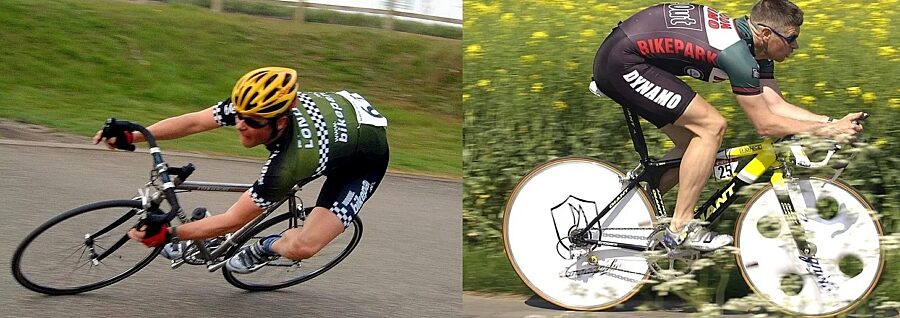
Racing at Eastway - left - folded into an insane TT position - right - I couldn't and shouldn't fold into either now
"The rider is responsible for 75–80% of total bike and rider drag package"
The Inequality of Maths & The Performance Principle
All numbers are not treated equally or should I say, given equal weight. The bike manufacturers are expending huge sums of money in wind-tunnels examining: drag, yaw angles, watts expended versus watts saved, at speeds that are irrelevant to some of us at least.
Precisely because it gives them another arena to compete within. You may like the look of bike (A) but Bike (B) has better drag numbers, dammit - ceteris paribus, you may well go for bike (B).
In addition - Bike companies generally reserve their most aggressive geometry philosophy for their aero road bike platforms. Firstly because all the aerodynamics in the world amounts to zero unless the rider is folded origami-like into an aero-proximal position. Remember, the rider is responsible for 75–80% of total bike and rider drag package - a vital data-point that we generally give less prominence. Ergo - the bike’s aero credentials mean zip unless you can match them with your own athletic flexibility to shrink-wrap into a pro-alike silhouette.
And secondly because these bikes also have to go to professional riders to win races on. We are effectively riding their bikes and they are riding our bikes. Even then pro riders often add a -17 degree 140mm stem to achieve their race-winning and preferred attack-attack, position - it is their job to win.
Real World Riding
Let’s consider some theoretical modelling, that aims to predict how more different riders interact with real world on a bicycle. Please look at the table below - here I am comparing an aero framed bike with 40-50mm deep-section carbon wheels, with a round-tubed titanium framed bike with the similar 40-50mm deep-section carbon wheels with concealed cables like this LANDRACE Tupelo V2. I have formulated the table to express how much power or watts are saved riding the aero bike compared to riding the round-tubed titanium bike, at speeds from 25km through to 50kmh. Then we can extrapolate what this means for different riders with various power capabilities.
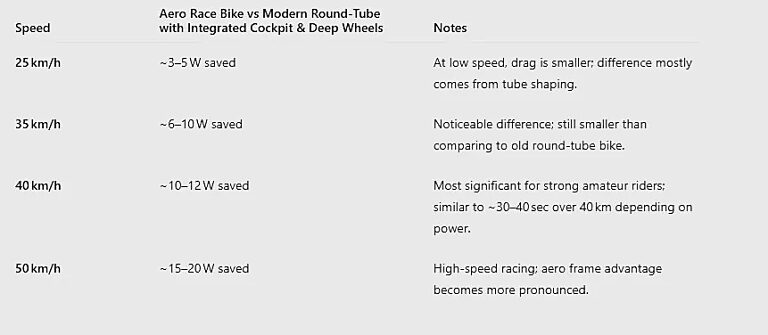
Estimated Watt Savings vs Modern Round‑Tube Bike - note these are estimated numbers - I used AI and established data points
"Ergo - the bike’s aero credentials mean zip unless you can match them with your own athletic flexibility to shrink-wrap into a pro-alike silhouette"
Is Your FTP 450 Watts
Now, if you are the kind of rider that has easy and regular access to 450ish watts - can I suggest that you please close this Substack down - you have stumbled across this essay in error (unless you also have some kind of hip impingement that affects you on your bike) - see case studies below.
If you make 450 watts and you are riding with good ranges, then you can expect to save at least 15-20 watts when riding around at your steady-state 50kmh. Aerodynamics has real value to you and riding an aero frame will save you a healthy 20 watts over a comparable round-tubed bike, with concealed cables and deep-section wheels.
Is Your FTP 280-300 Watts?
If you have circa 280-300 watts readily to hand, for at least half an hour, any time of the day or night, then the data suggests an aero road bike will save you around 10-12 watts over a round-tubed titanium or steel bike (deep-section wheels and concealed cables) when you are riding close to your theoretical maximum of 40kmh. When you are riding a more sustainable 30-35kmh you will be giving up between 6-10 watts riding around on your titanium bike versus your high-zoot carbon aero bike.
Is Your FTP 180-220 Watts?
Okay, if you ride around all the time at your FTP or around 35kmh, you will be saving 6-10 watts if you ride an aero bike over the alternative steel or titanium round-tubed bike (with 40-50mm deep-section wheels and concealed cables). Having a more chilled day and limit yourself to an average of 25kmh and you will have saved around 3-5 watts riding your aero bike. To be clear 3-5 watts is a rounding error - the difference between a locked elbow versus a 20° bend. Insignificant to any of us on any normal day.
But…
And it is the biggest but. These huge or modest power increases (depending upon your perception), are all predicated on one vital assumption - that you have sufficient ranges of motion (ROM) to function in the aggressive position that a typical aero-framed bike demands. It is little known or discussed, but it is trivially easy to leak 20-30% of your power if the set-up is dictates a position that your body cannot cope with. We see it all the time at Cyclefit. Anyone (pro or amateur) with a hip-range or function issue is likely to have a very costly biomechanical adaptation. It could be a hip-in-flexion issue (that could potentially extended over time through specific stretches) or an actual hip-impingement or impediment. The former is a soft-tissue dysfunction (muscles, tendons etc.). The latter relates to bones and joints (not so easy to change quickly or even at all).
Case-Study
Our case-study rider (video above and below) is an ex-professional racer who was struggling post-injury. Hip-range issues mean that she is struggling to cope at the top of the pedal-stroke also. She is both twisting on the saddle and also abducting the right hip and knee as a particularly expensive adaptation. The price is being paid in pain and significant consequential loss of power. Nichola and I worked together to optimise her bike-position and S+C program (Nichola) to make sure she was functional and resilient to the loads of intense cycling. Bike-fitting is inevitably process and NOT event with an injured rider. As they rehab, become stronger and increase ranges, so the bike-position can change to reflect them. To be clear - aiming for aero with this kind of rider will amplify all the problems and pain. It would be inappropriate.
Ongoing work with post-injury, ex-professional rider. Before - left and after - right.
"We worked with a professional rider who lost 23% of their power when transitioning from road to TT position - or over a 100 watts"
The Hip is King
Power may be delivered at the foot but it is substantially authored at the hip. The hip, for cyclists, has regal importance because we demand power be produced in large quantities when it is closed (at the top of the pedal-stroke). This is contrast to running when maximum power is produced when we are in contact with the ground and the hip is open (the exception is running up steps or a steep hill).
Hip-related problems are now the most common cause of pain and performance loss that we see at Cyclefit. Something has changed because this did not use to be the case - historically the most common problems that would be solving for, would to be knee and foot, followed by back and saddle.
Hip-related problems regularly affect professional as well as amateur riders. They can often be triggered by a crash and resultant injury to the hip or pelvis. We worked intensively with a professional rider who lost 23% of their power when transitioning from road to TT position - or over a 100 watts!
To be clear; there is no aero in the world worth 100 watts = The Performance Principle
The performance principle
A useful guideline for us bike-fitters is:
Never sacrifice joint-function for aerodynamics
Because if the joint cannot move freely and function properly, the resultant power-loss will likely supersede drag-saving.
Check Your Aero Dividend
A quick re-cap:
- Bicycle frames are increasingly designed with elaborate aero profiles, to make them faster by reducing aerodynamic drag.
- Bikes are often tested in the wind-tunnel without the component ultimately responsible for most of the drag - the rider.
- Drag increases exponentially with speed — which is why aero matters proportionally more at 50 km/h than at 25 km/h.
- The frame, wheels and components together only form about 20% of your total aerodynamic drag profile.
- You are by far the most important component of drag - at around 80%.
Therefore, the relevance of aero to us as individuals will be predicated upon four things:
- Our individual physiology - particularly hip ranges of motion (flexion and medial/lateral rotation).
- The speed at which we intend to ride, for most of the time.
- Our sustainable power - I would recommend using one-hour FTP as your guide.
- How and where we like to ride - road, gravel, trail, touring? What is important to us in our riding experience - speed, comfort, the view? Our riding confidence also matters. A lack of confidence may indicate a custom bike made with more forgiving tube-shapes and materials.
Earn Your Position
If you are set on aero as a minimum requirement, but you also have some issues that would generally preclude a low and long position. Then my advice would be to look at a custom option or less aggressive geometry platform. And to embark upon a structured S+C (strength and conditioning) program to get you match fit.
That is to say, you have to - Earn Your Position!
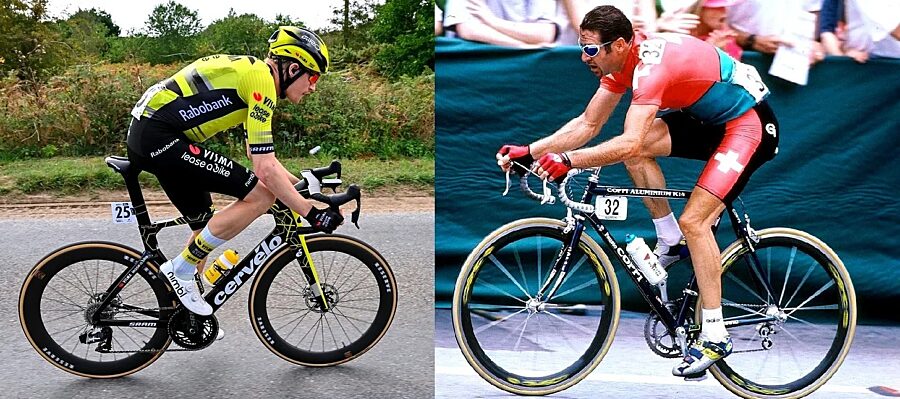
Modern 'aero' (left) versus classic position (right). Pascal Richard (r) rides his Serotta Legend Titanium to Olympic gold in Atlanta - 1996.
Ben Serotta & Rob Vandermark (Seven Founder) Comment:
"Hey Phil - my riposte to your piece - Real life doesn’t take place riding alone in a wind tunnel, I’d reckon that the average difference on any given ride outdoors (many more variables added), either in a group or by yourself (still more variables) reduces the net cumulated over time differences in your comparisons…. And then there are the unstated deficits that can come along with aero equipment, like the energy spent keeping the bike running straight in a cross wind, or the safety implications of same."
Ben Serotta
"Dear Phil - you write about the trade-off between aerodynamic watts savings versus the importance of rider-position watts production. Seven’s research indicates that there is no trade-off, as aerodynamic-watt savings have no positive impact on ProTour racers’ actual speed. In fact, a clear inverse relationship exists: not only does an aero riding position hinder actual power production and overall speed (as you’ve written), but aerodynamic bike designs also reduce average race speeds.
How is this concept so at odds with the data and marketing words provided by bike brands? Wind-tunnel data collection and real-world riding yield very different results.
The good news is that riders can ignore aerodynamic claims because they don’t matter in group-riding situations. Just get your position right (as you advise) and choose the bike that handles best for you and aids in body recovery; don’t be concerned with aerodynamics. That combination will provide you with more speed and significantly improved long-term rider durability than any aero bike.
Some important races have gotten faster, but that doesn’t mean that racing in general has. If aerodynamics did what bike brands claim, overall race times would be increasing, particularly where aerodynamics matter most, like the WC individual time trial. That is not the case.
The point is that riders achieve the best results by optimizing their on-bike position and choosing the bike they feel most in control of, and that supports rider recovery and improves athlete durability over time. This approach provides more watts and significantly better long-term performance gains than any aero bike."
Rob Vandermark - Seven Cycles Founder
Suggested Reading:
Phil's Myth of Aero on Substack
Aerodynamic Gains Are Marginal by Rob Vandermark
Aero-bikes are for Pro's - you are better off with a bike that fits you - Warren Rossiter - Bike-Radar
Article Notes:
Rider body = ~75–80% of total drag
Wheels = ~10–15% of total drag
Frame = ~5–10% of total drag
The body is the most important component
CdA = Drag Coefficient (Cd) × Frontal Area (A)
Measured in square meters (m²) and represents how much drag is exerted on the rider + bike is they move through the air.
Lower CdA = less drag = faster for the same power.
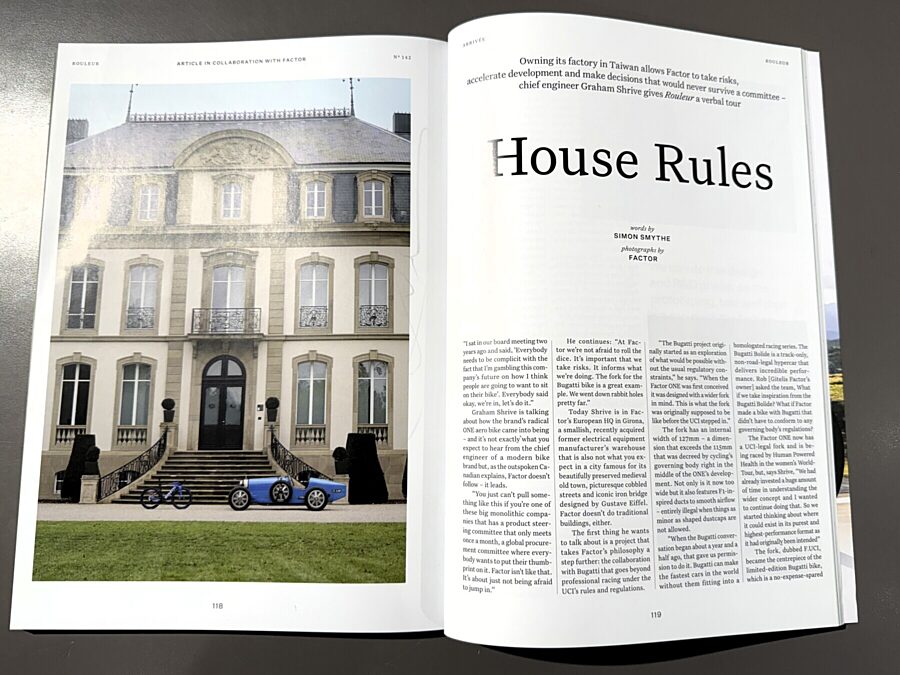
Rouleur (Classics Issue) 'House Rules'
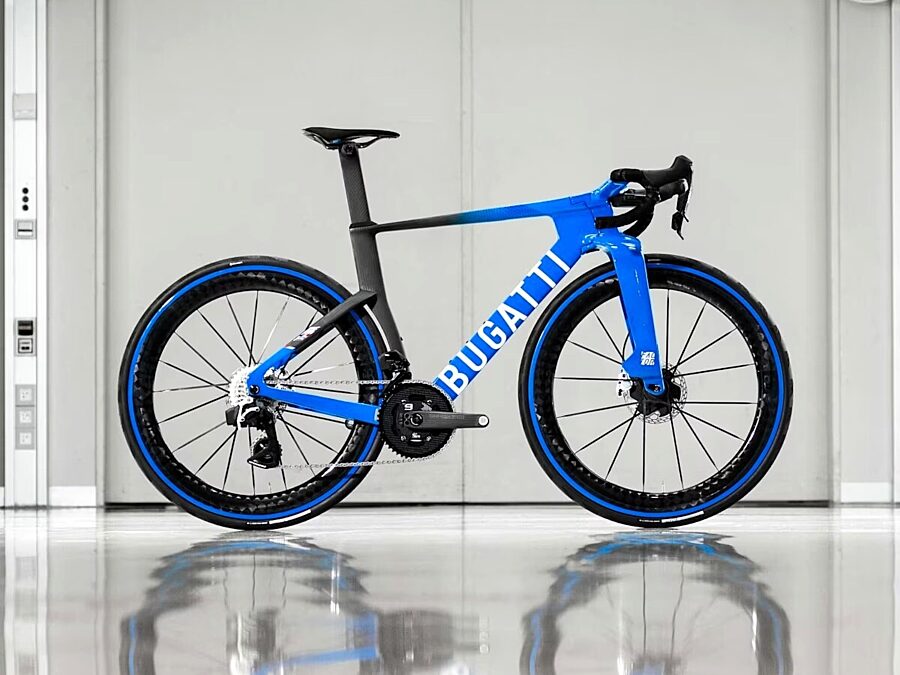
Bugatti Factor
Postcript:
“Everybody needs to be complicit with the fact that I’m gambling this company’s future on how I think people are going to want to sit on their bike”
Factor Bicycle’s Chief Engineer, Graham Shrive - Rouleur Magazine (Classics Issue)
In bicycles and as in politics, one needs to be careful and clear when making references to the 'people'.
We, The People
Possibly the most famous example of structural vagueness was the use of “We The People” in the 1787 US Constitution; which clearly excluded the female half of the population, who didn't get the right to vote until the 19th amendment in 1920.
When Graham Shrive refers to people, does he mean professional athletes, racers, or potentially any of us. And when he refers to - how people are going to want to sit on their bike - what does that mean? And is that all that should pre-qualify me? That I want to sit on a Factor Bugatti?
In one sense at least, I think Graham is quite right. Bikes are changing shape and focus, and people are understandably magnetised by all of the advantages that technology offers. The lure of aero is the promise that for the same power we can all go faster. It is free speed and efficiency. And sometimes that is indeed the case. Ceteris paribus.
Ceteris Paribus
Economists use phrase ceteris paribus - or other things being equal, to allow them to isolate one variable by assuming that nothing changes. Ceteris paribus we will tend to drink more coffee when the price is reduced (especially cyclists as it happens).
Ceteris paribus we will be faster if we switch to an aero bike from a round-tubed one. But it is the abstraction of ceteris paribus makes it as least as fraught in bike-fitting as it is in economics.
People versus The Person
The frequent downstream effects for bike-fitters, are people who are struggling to function in the position that their bike currently prescribes. Things have indeed changed.
Bike-fitting, in that sense, is not about ‘people’, it is about 'the person'.
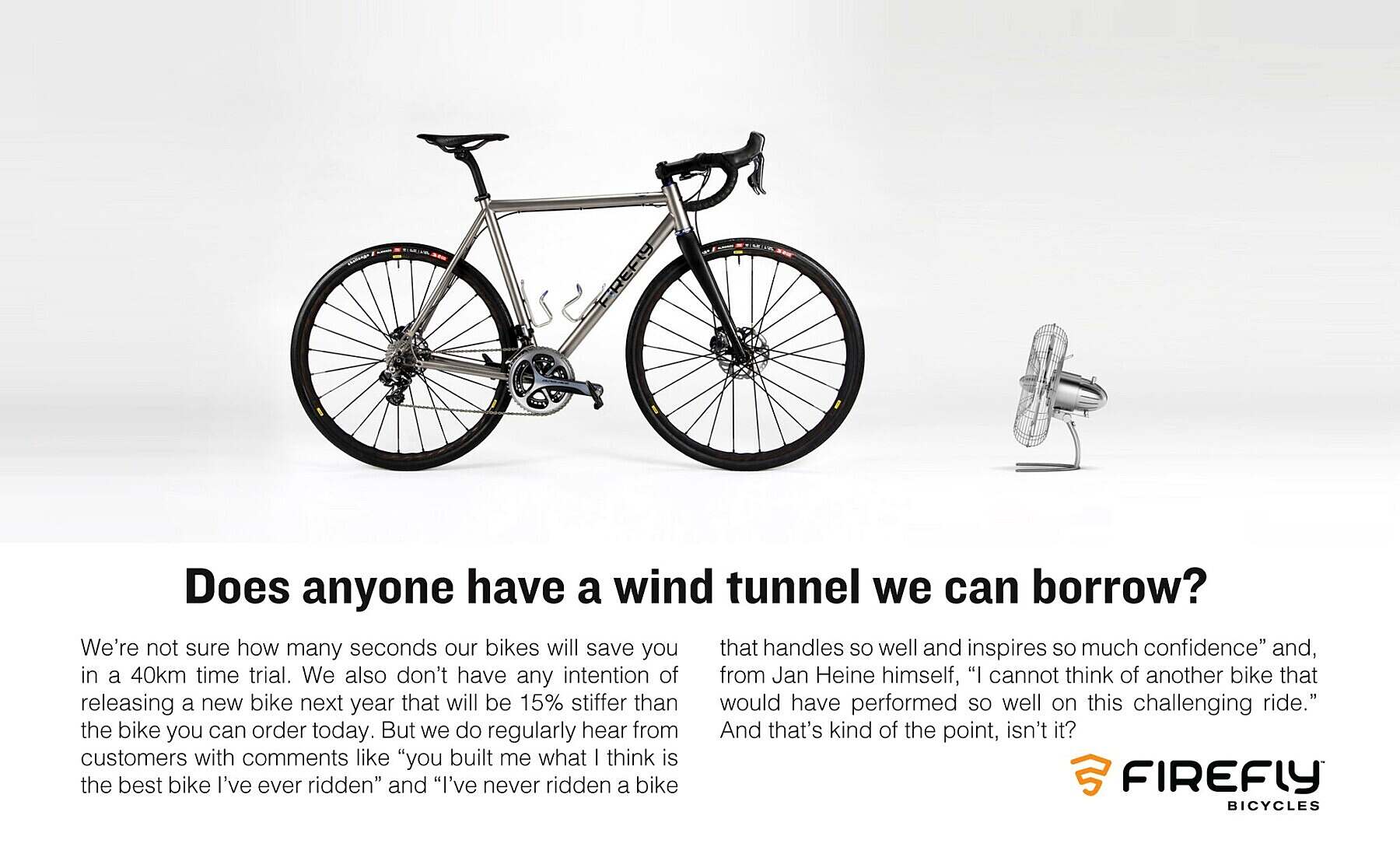
Firefly prefer to use humour to address the 'aero' proposition